Dialectical Behaviour Therapy
- Home
- Services
What is Dialectical Behaviour Therapy?
Dialectical behaviour therapy, or DBT, is an evidence-based treatment modality that focuses on changing unhelpful thinking patterns. The word “dialectical” means “opposing forces”, which supports the therapy’s goal of combining opposing ideas: change and acceptance.
DBT draws on principles of CBT (hyperlink for CBT page), but it was adapted to support people experiencing severe or chronic emotional dysregulation. DBT works in collaboration with CBT. For example, in moments of significant dysregulation, DBT’s distress tolerance skills act as a necessary first step when the nervous system is flooded. When the person is less triggered by the situation, they can turn to CBT to assist with changing how they think and act, resulting in living a happier and more productive life.
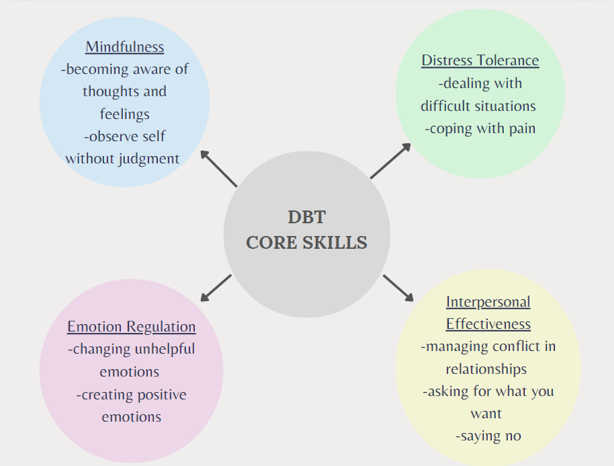
DBT has four main core skills: mindfulness, accepting & tolerating distress, regulating emotions, and interpersonal effectiveness.
Who does DBT help?
DBT is a skills-based therapy model that can be used across many populations, including teens and adults. DBT is especially effective for people who consistently struggle to manage and regulate their emotions. It was originally created to treat chronic suicidality and borderline personality disorder; however, it has evolved to treat many more mental disorders including, but not limited to:
- Anxiety
- Depression
- Post-traumatic stress disorder (PTSD)
- Eating disorders
- Self-harm
- Substance abuse disorders
- Anger
- ADHD (specifically impulse control)
How long will it take to
feel better?
As DBT is a skills-based therapy, learning begins in the first few sessions. DBT offers nearly 40 different strategies, giving clients tangible ways to manage significant life challenges.
In its purest form, DBT works best when learned in a group setting and with independent coaching from a therapist; however, focusing on some or all of the core skills can be done in individual therapy.
Not sure if DBT is for you? We welcome you to book a free 15-consult with one of our trained therapists: e-mail at info@brockcounselling.ca, or call or text: 905-320-2342.
The Process
What to expect when you reach out
Starting therapy can feel like a big step. Here’s how the process works at Brock Counselling, so you know exactly what to expect.
1
Brief Consultation
Therapy begins with an initial 15-min phone consultation to discuss individual needs, as well as explore fit. Connection with a therapist is important and integral for working toward change. This connection will begin to be explored during the phone consultation.
This is also a good place to ask your questions about the therapy process.
2
Your First Session
During this session, your therapist will spend time getting to know you and discussing your goals for therapy. Goals can be determined solely by you, or in collaboration with your therapist.
This appointment requires you to bring nothing, other than a willingness to participate.
3
Ongoing Support
At the end of the first session, you and your therapist will discuss frequency of sessions, as well as a plan for future sessions. Therapy is not a "one size fits all." Sessions are tailored to your individual needs. As you begin to heal, the frequency may change, giving more time in between sessions to allow you to utilize skills and begin to cope.
Not Sure Where to Start?
Choosing to reach out is the hardest part. Our team is here to answer your questions and help you find the right fit — no pressure, no commitment.
Ready When You Are
Book a Free Phone Consultation
Book a 15-minute phone consultation with one of our therapists. During this call, we’ll discuss your needs and goals and explore how our tailored approach can support your healing journey.
FAQs
How do I book an appointment?
There are many ways to book an appointment:
NEW CLIENTS: If you are a NEW client to Brock Counselling, please follow this link to send us a message: Contact Brock Counselling for Support and Therapy Services.
You can also book directly by e-mailing info@brockcounselling.ca or calling us at 905-320-2342.
EXISTING CLIENTS: If you are a CURRENT client, please use the Owl Portal link on the top right-hand side of the page. This will take you to the online booking platform: OWL, where you can book an appointment.
Alternatively, you can reach out to your therapist directly to book an appointment or contact info@brockcounselling.ca.
Therapy may be a good fit if:
- You have a problem that is interfering with your daily life;
- You have unresolved negative feelings that are affecting your work, home tasks, parenting, or relationships;
- Your family doctor recommended that you speak with a social worker or psychotherapist;
- You have been diagnosed with a mental health condition;
- Your coping strategies are harmful to your health and well-being (drinking alcohol in excess, using drugs, disordered eating, isolation, ‘doom scrolling’); OR
- You are looking for impartial feedback about your life and life choices.
People begin therapy for many different reasons. You do not have to have everything figured out before reaching out for support.
Therapy welcomes all individuals and requires no prior experience.
You do not need to bring or prepare anything for your first appointment – other than a willingness to participate and engage in the therapy process.
Your therapist will guide and support you through the first appointment. At the end of this appointment, your therapist will help you with setting goals and discussing what your hopes are for your therapy journey.
The primary differences between an RSW (Registered Social Worker) and a Psychologist are their education and the services they provide.
RSWs hold a Bachelor of Social Work or a Master of Social Work. This allows them to provide psychotherapy in Ontario.
Psychologists hold of Doctor of Psychology. While they can provide psychotherapy, most psychologists exclusively provide mental health assessments (i.e., Psychoeducational assessments, ADHD assessments, autism assessments).
It is best to speak directly with the professional about what services they provide.
Yes! Evening appointments are offered most nights of the week.
Weekend appointments are offered on Saturday morning and early afternoon.
Yes. What you share is confidential and your privacy is prioritized.
The information you share during a therapy session is protected by the Personal Health Information Protection Act (PHIPA), ensuring a safe and trusting therapeutic relationships between you and your therapist.
If you chose to share information with your spouse, family, employer, or other individual, you would sign a written consent. You have the right to revoke this written consent at any time.
Short answer, no.
Services are not offered outside of Ontario.
Registered Social Workers and Registered Psychotherapists are governed by separate regulatory bodies.
The Ontario College of Social Workers restricts services to clients located in Ontario.
The College of Registered Psychotherapists also restricts services to clients located in Ontario.
Absolutely!
In fact, fit is very important as it reflects the compatibility between you and your therapist.
Research consistently supports that the relationship between a client and therapist is the single most predictor in therapy success – as opposed to treatment type used, number of sessions, and diagnosis.
It may be a good fit if:
- You feel comfortable opening up, especially about the hard or embarrassing stuff;
- You feel heard, understood, and respected;
- You feel comfortable with your therapist challenging you in healthy ways;
- You genuinely want to attend sessions, even when what you’re talking about is difficult.
Yes, some insurance companies allow for direct billing. Please reach out to the practice directly at info@brockcounselling.ca to inquire if your insurance company is on the list of approvals.
Contact
Get In Touch
We are here to answer your questions and help you begin your healing journey. Contact us via phone, email, or visit our office to get started.
Address
3344 Mainway, Burlington, ON, L7M 1A7
Text/Phone
905-320-2342
info@brockcounselling.ca